Permanent/Temporary: A short film about the reconstruction of Poshtova Square

For more than three years, people have been deprived of convenient access through Poshtova Square to the Magdeburg Rights Monument and the Park Bridge, which connects to Trukhaniv Island. During that time, four consecutive heads of the Kyiv City State Administration have held office, and Poshtova Square was supposed to be “reopened after renovation” six times.
Oleksiy Bykov and Petro Baranov made a short documentary about this issue. Maksym Popov wrote the foreword.
As we move through the city, we become more aware of the rhythm of time and space. In an urban context, movement remains constant, while subjects of this movement – of the city’s evolution – change and are therefore temporary.
Permanent/Temporary addresses the urban environment as a model of social relations and a product of human interactions. It is widely recognised that any object, house, neighbourhood, city, or state is a material embodiment of human relations. This argument holds true at the urban level: traffic jams, the neglect of public spaces, and the privatisation of urban recreational areas are merely byproducts of social relations. Thus, the authors of Permanent/Temporary expose the absurdity of cosmetic changes while simultaneously pointing to the need to transform the very model of our relationships.
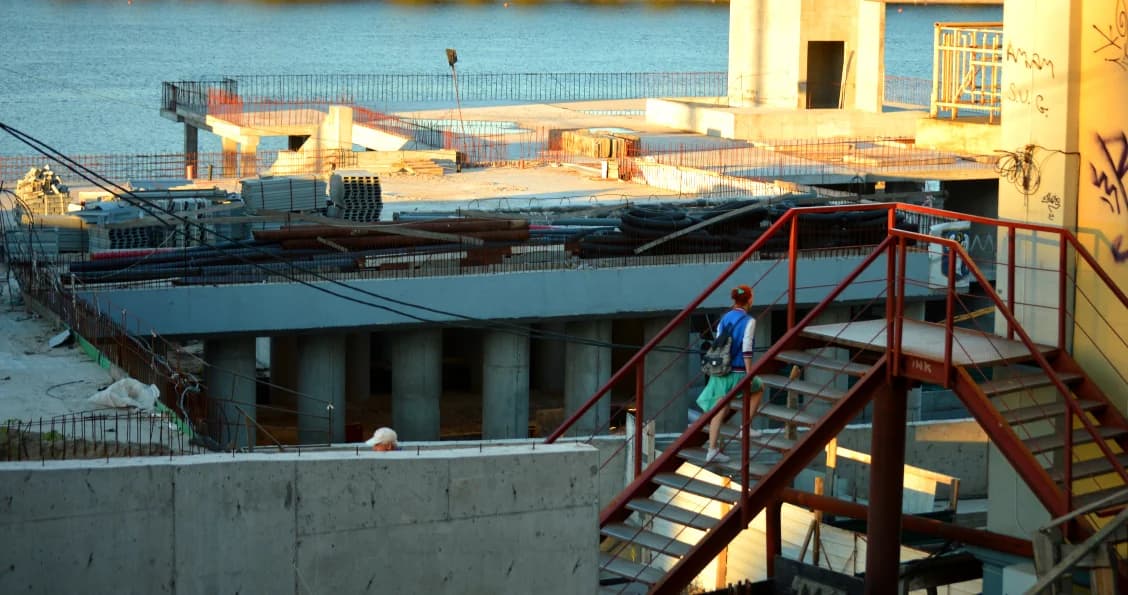
At the centre of the story is a staircase that serves as a metaphor for social processes in Ukraine. This staircase also functions as a pedestrian crossing on Poshtova Square, used by hundreds of people every day. It is a temporary passage that allows people to get from Volodymyrskyi Descent to the riverbank. The square is under construction: a foundation pit has been excavated, and heavy machinery is at work. People navigate the staircase carrying bicycles, pushing baby strollers, and hauling bags, going up and down, only to climb back up again. Some pay little attention to this obstacle as they talk to their companions; others struggle because of their age. Some stop to let people with bicycles and strollers pass, while others simply observe the construction.
A change takes place. The bannister is now a different colour: it has been painted in the national flag's colours, but the traffic problem remains. The inability – or unwillingness – to solve the problem gives it symbolic significance. The staircase takes on an additional, patriotic function. Instead of solving the problem itself, the approach to it changes.
Today, social tensions in Ukrainian society are as high as the intensity of movement up and down the staircase. State propaganda is saturated with patriotism, yet the authorities fail to implement effective solutions, shifting the problem into the symbolic realm. During Maidan protests, people realised they could change the government without waiting for elections. Today, however, changes are accumulating and creating the preconditions for a new Maidan. The question arises: what remains temporary, and what is permanent – a social process or the form it takes, embodied here by a staircase?
Foreword: Maksym Popov, an architect, head of the MIST NGO.